
Short answer: this power outage checklist ranks what to power, in this order: (1) any device someone’s health depends on, following its manufacturer’s guidance; (2) communication: phones and internet; (3) light; (4) food storage; (5) comfort. Low-watt items in the first three groups cost very little battery, so cover them first.
Power outage checklist: priority list
| Priority | What | Typical power need | Notes |
|---|---|---|---|
| 1 | Devices someone depends on | Varies | Follow the manufacturer and your doctor; plan for these first |
| 2 | Phones | Small; a power bank works | Charge everything before a forecast storm |
| 2 | Modem + Wi-Fi router | About 12–13 W combined | See keeping Wi-Fi on |
| 3 | LED lights | A few watts each | Battery lanterns avoid using the power station at all |
| 4 | Refrigerator | Efficient full-size: about 38–62 W average | Food stays safe up to 4 hours unpowered with the door closed |
| 4 | Freezer | Varies | Full freezer holds about 48 hours, half-full about 24, door closed |
| 5 | Fans, TV, laptop | Tens of watts | Only if the battery budget allows |
Food-safety times come from FoodSafety.gov. Refrigerator averages are calculated from ENERGY STAR certified models rated about 330–540 kWh/year.

Worked example: a 12-hour outage on a 1,000 Wh station
Here is the power outage checklist turned into numbers, using the site’s 85% inverter factor (1,000 Wh × 0.85 = 850 Wh usable):
| Priority | Load | Math | Energy |
|---|---|---|---|
| Communication | Modem + router, about 13 W | 13 × 12 h | 156 Wh |
| Light | Two 9 W LED bulbs | 18 × 6 h | 108 Wh |
| Food | Fridge rated 400 kWh/year, about 46 W | 46 × 12 h | 552 Wh |
| Total | 816 Wh |
That fits, with about 34 Wh left for phone charging. Add a space heater and it doesn’t: a 1,500 W heater would use the whole battery in about 34 minutes. Size your own list with the 5-step sizing guide.
Before the outage: power outage checklist items
- Charge the power station, power banks and phones.
- Put a thermometer in the fridge and freezer; 40°F is the food-safety line.
- Test CO alarms if anyone in the area will run a generator (CPSC recommends monthly tests).
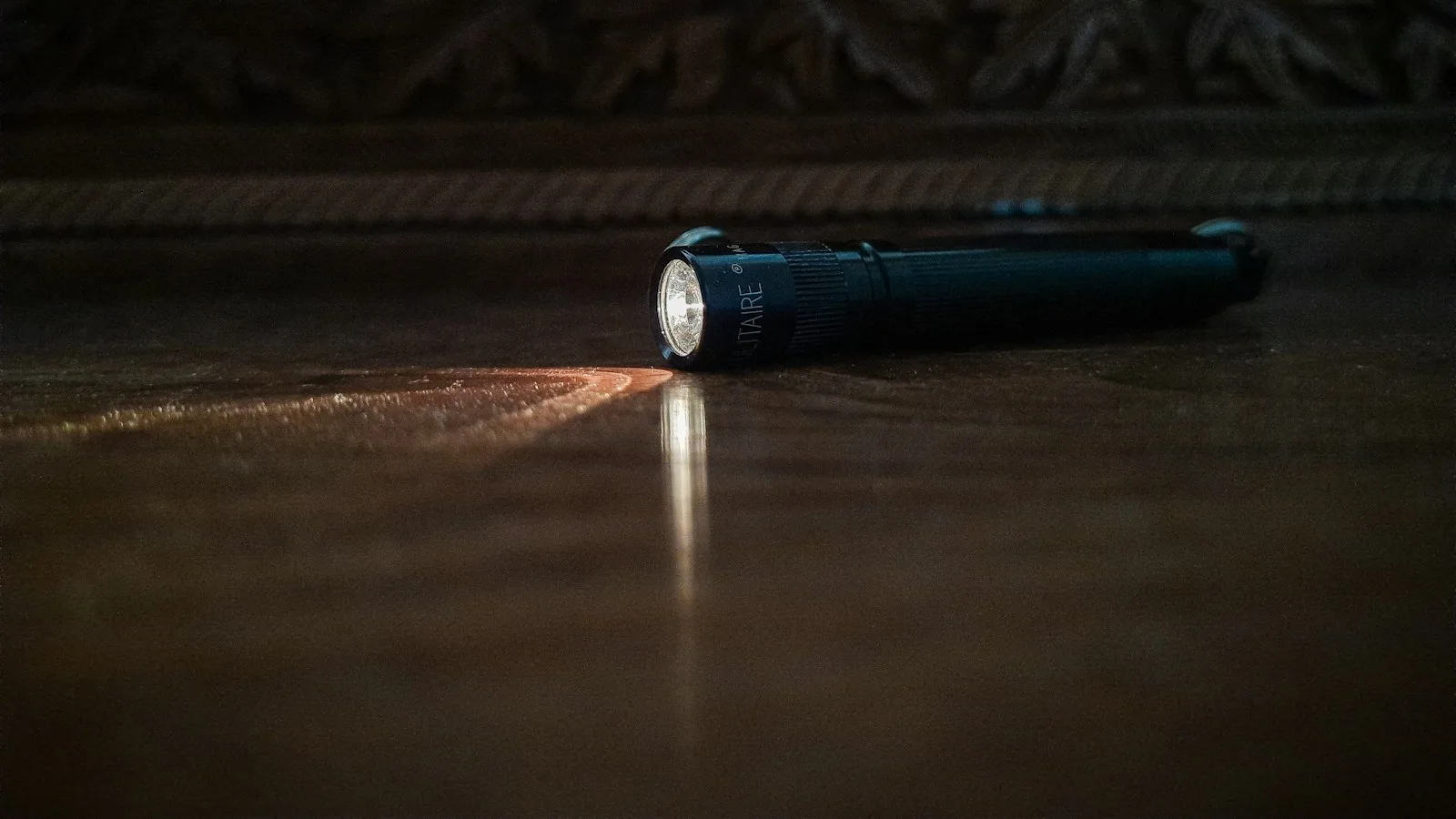
- Have a flashlight for every household member (Ready.gov).
- Find out whether your home phone works in an outage and how long its backup battery lasts.
- Install CO detectors with battery backup on every level of the home (Ready.gov).
- Talk to your medical provider about a plan for powered medical devices and refrigerated medicines (Ready.gov).
- Know your loads: measure them or estimate with the runtime calculator.
During the outage
- Keep fridge and freezer doors closed. Ready.gov says a refrigerator keeps food cold for about 4 hours and a full freezer holds its temperature for about 48 hours.
- Turn off or unplug appliances and electronics you aren’t using; Ready.gov warns power may return with surges or spikes.
- Never heat the home with a gas stove or oven (Ready.gov).
- Check with local officials about heating and cooling locations near you.
- Turn off the power station’s AC output when nothing needs it.
- Run high-draw items only when necessary, and one at a time.
- Never run a gas generator indoors or within 20 feet of the home (why).
After the outage
- Check fridge and freezer temperatures before eating anything perishable.
- Throw out food that sat at 40°F or higher for 2 hours or more, or that has an unusual odor, color or texture (Ready.gov).
- If power was out for more than a day, Ready.gov advises discarding medication that should be refrigerated unless the label says otherwise, and asking your doctor or pharmacist for a new supply.
- Recharge the power station right away for the next one.
If the outage happens in winter, see How to Stay Warm During a Power Outage for a safe heating plan.
Common mistakes
- Ignoring the power outage checklist order and spending the battery on comfort first, then running out before the fridge or phones.
- Opening the fridge to check on it. Use a thermometer you can read with the door closed.
- Leaving the power station’s AC output on overnight with nothing plugged in.
- Forgetting a plan for anyone who depends on a powered medical device.
FAQ
What should be on a power outage checklist?
Flashlights, charged phones and power banks, a way to keep the modem and router on, a fridge thermometer, CO detectors with battery backup, and a plan for medical needs. Then rank what to power in the order above.
Does a power outage checklist change in winter?
The order stays the same, but warmth becomes a safety issue. Use blankets and one closed room rather than battery heat, and never use fuel-burning heaters or a gas oven indoors.
How long will food last in the fridge without power?
About 4 hours in a closed refrigerator and about 48 hours in a full freezer, according to Ready.gov.
Should I unplug things during a power outage?
Yes for anything you aren’t using. Ready.gov notes power may return with momentary surges or spikes that can damage equipment.
For keep-or-toss rules on food, see how long food lasts in a fridge without power.
Sources: Ready.gov, Power Outages; FoodSafety.gov; ENERGY STAR; CPSC; Ericsson. Written by Lucas, Electrical Engineer.