
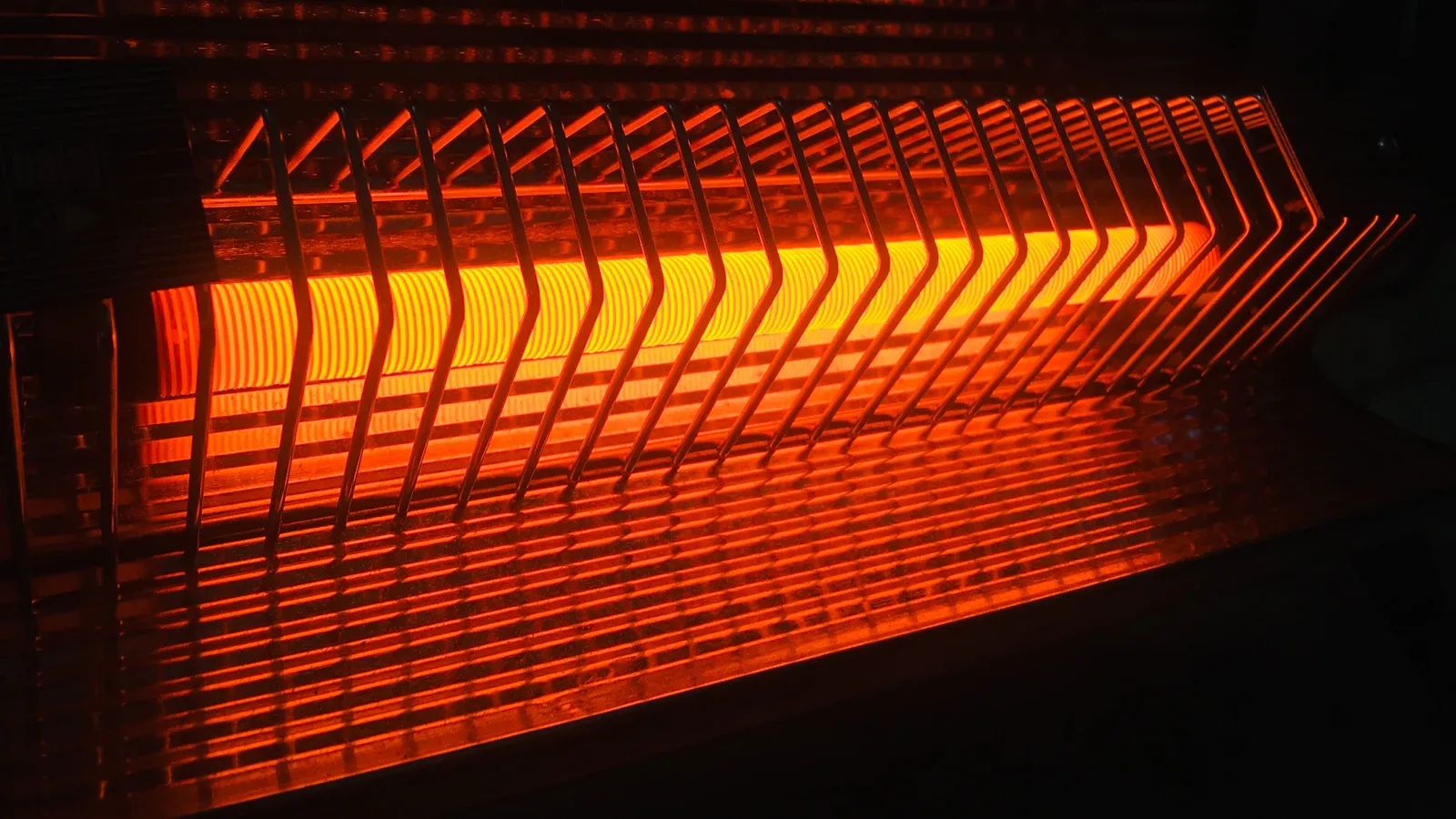
Short answer: can a power station run a space heater? Yes, but not for long. If your space heater’s label says 1,500 W, a 1,000 Wh power station runs it for only about 34 minutes on high, and only if the station’s inverter is rated for at least 1,500 W continuous. On a 750 W low setting you get about 68 minutes. For warmth through the night, an electric blanket beats any power station space heater setup.
The formula
Runtime is the energy in the battery divided by the power the heater draws, minus what the inverter loses converting battery DC to 120 V AC:
Runtime (hours) = battery Wh × 0.85 ÷ heater watts
The 0.85 is a typical inverter efficiency we use across this site. If you want the background on why watts and watt-hours are different things, see Watts vs Watt-Hours.
Worked example: a 2,000 Wh power station and a heater set to 1,500 W. 2,000 × 0.85 = 1,700 Wh usable. 1,700 ÷ 1,500 = 1.13 hours, or about 68 minutes.

Power station space heater runtime table
These rows assume the heating element stays on the whole time, which is close to what happens in a cold house with no other heat source.
| Power station capacity | Heater on 1,500 W | Heater on 750 W | Small 500 W heater |
|---|---|---|---|
| 500 Wh | about 17 min | about 34 min | about 51 min |
| 1,000 Wh | about 34 min | about 68 min | about 1 h 42 min |
| 2,000 Wh | about 68 min | about 2 h 16 min | about 3 h 24 min |
| 3,000 Wh | about 1 h 42 min | about 3 h 24 min | about 5 h 6 min |
Calculated with the formula above (85% efficiency). If your heater has a thermostat and the room is already warm, it will cycle off part of the time and the battery lasts longer. The 750 W and 500 W columns only matter if your heater actually has those settings, so read the label on the heater itself.
Check the output rating before the capacity
In any power station space heater setup, capacity (Wh) decides how long. The continuous AC output rating (W) decides whether the heater runs at all. A 1,500 W heater at 120 V draws 1,500 ÷ 120 = 12.5 A. If the station’s inverter is rated below the heater’s wattage, it will typically shut the output off as an overload. A station rated for a few hundred watts cannot run any setting of a 750 W to 1,500 W heater.
The heating element itself is a resistive load, so it does not have the startup spike a refrigerator compressor has. Fan-forced heaters add a small fan motor, but the element is what sizes the inverter. More on surges in Running vs Starting Watts.

Why heat burns through a battery so fast
One hour of a heater on 1,500 W uses 1,500 Wh. An ENERGY STAR full-size refrigerator rated 330 to 540 kWh per year averages about 0.9 to 1.5 kWh per day (see our refrigerator runtime guide). So one hour of space heating costs roughly what that fridge uses in one to one and a half days.
That is why the useful question during an outage is usually not “how long will it run the heater?” but “what should the battery power instead?” Food, light, phones and Wi-Fi go much further. Our power outage checklist walks through that order.
Heat your body, not the room
An electric blanket or heated mattress pad puts heat directly on you instead of into the air of a cold room. Check the wattage on its label. For an example blanket rated 100 W running at full power:
| Power station capacity | 100 W electric blanket |
|---|---|
| 500 Wh | about 4.2 h |
| 1,000 Wh | about 8.5 h |
| 2,000 Wh | about 17 h |
A 1,000 Wh station that gives you 34 minutes of space heater can cover a full night with a blanket like that, and low settings stretch it further. For a full plan, see How to Stay Warm During a Power Outage.

Safety rules that still apply on battery power
- No extension cords or power strips. The U.S. Consumer Product Safety Commission says to never power a heater with an extension cord or power strip. In a power station space heater setup, plug the heater straight into the station’s AC outlet, never into a strip plugged into the station.
- Keep 3 feet of clearance. CPSC advises keeping things that can burn at least 3 feet from the front, sides and rear of the heater.
- Check the plug. The plug should fit tightly. If the cord or plug gets hot, stop using it.
- Never use fuel-burning appliances for heat indoors. Ready.gov warns against heating a home with a gas stove or oven, and gas generators belong outdoors. See why you should never run a generator indoors.
Worked example: one cold night on a 2,000 Wh station
Here is how the numbers play out for a typical overnight outage of 12 hours, using the site’s standard 85% inverter efficiency. A 2,000 Wh station gives about 2,000 × 0.85 = 1,700 Wh of usable AC energy.
| Load | How we got the number | Energy for the night |
|---|---|---|
| Refrigerator rated 450 kWh/year | 450,000 ÷ 8,760 ≈ 51 W average × 12 h | about 616 Wh |
| Router + modem | about 13 W × 12 h | about 156 Wh |
| Electric blanket, 100 W example | 100 W × 8 h | 800 Wh |
| Total | about 1,572 Wh |
That plan fits, with roughly 128 Wh to spare for phones and a lamp. Swap the blanket for a power station space heater setup at 1,500 W and the same 1,700 Wh is gone in about 68 minutes, with nothing left for the fridge. The refrigerator figure follows the method in our refrigerator runtime guide; use your own fridge’s EnergyGuide number if it differs.
Common mistakes
- Dividing Wh by heater watts without the 0.85 inverter loss, which overstates runtime by about 18%.
- Checking capacity but not continuous output, then finding the station shuts off as soon as the heater starts.
- Running the heater through a power strip or a thin extension cord to reach a chair.
- Draining the battery on heat in the first hour and having nothing left for the fridge or phones.
When this doesn’t apply
- Your heater isn’t 1,500 W. Power station space heater math always starts from the label, so use the number on yours in the formula, or enter it in the power station runtime calculator.
- Central heating. A furnace is hard-wired, not plugged in. Powering it from backup power is an electrical installation job for a licensed electrician, not a plug-and-play setup.
- Whole-home backup. Large battery systems wired into a home panel are a different category; see power station vs gas generator for how portable options compare.
FAQ
Can a 350 watt power station run a space heater?
Not a typical plug-in space heater. Even a 750 W low setting is more than double a 350 W output rating, so the station will overload and shut off.
How long can a portable power station run a space heater?
Divide the battery’s Wh by the heater’s watts and multiply by 0.85. At 1,500 W that works out to about 34 minutes per 1,000 Wh of battery, and about 68 minutes per 1,000 Wh on a 750 W low setting.
Can a portable power station run a small heater?
Yes, if the heater’s wattage is below the station’s continuous output. A 500 W heater on a 1,000 Wh station runs for about 1 hour 42 minutes.
What size power station do I need for a space heater?
The inverter must be rated above the heater’s watts. For energy, one hour at 1,500 W needs about 1,500 ÷ 0.85 ≈ 1,765 Wh of battery, and two hours need about 3,530 Wh. That is why most power station space heater plans only cover short bursts.
Is it safe to plug a space heater into a power station?
Follow the same rules as a wall outlet: plug it in directly, with no extension cord or power strip, and keep 3 feet of clearance around it.
Sources: CPSC, electric heater safety; U.S. Fire Administration, space heater cords; Ready.gov, Power Outages. Calculations by Lucas, Electrical Engineer. No products were tested for this guide.