
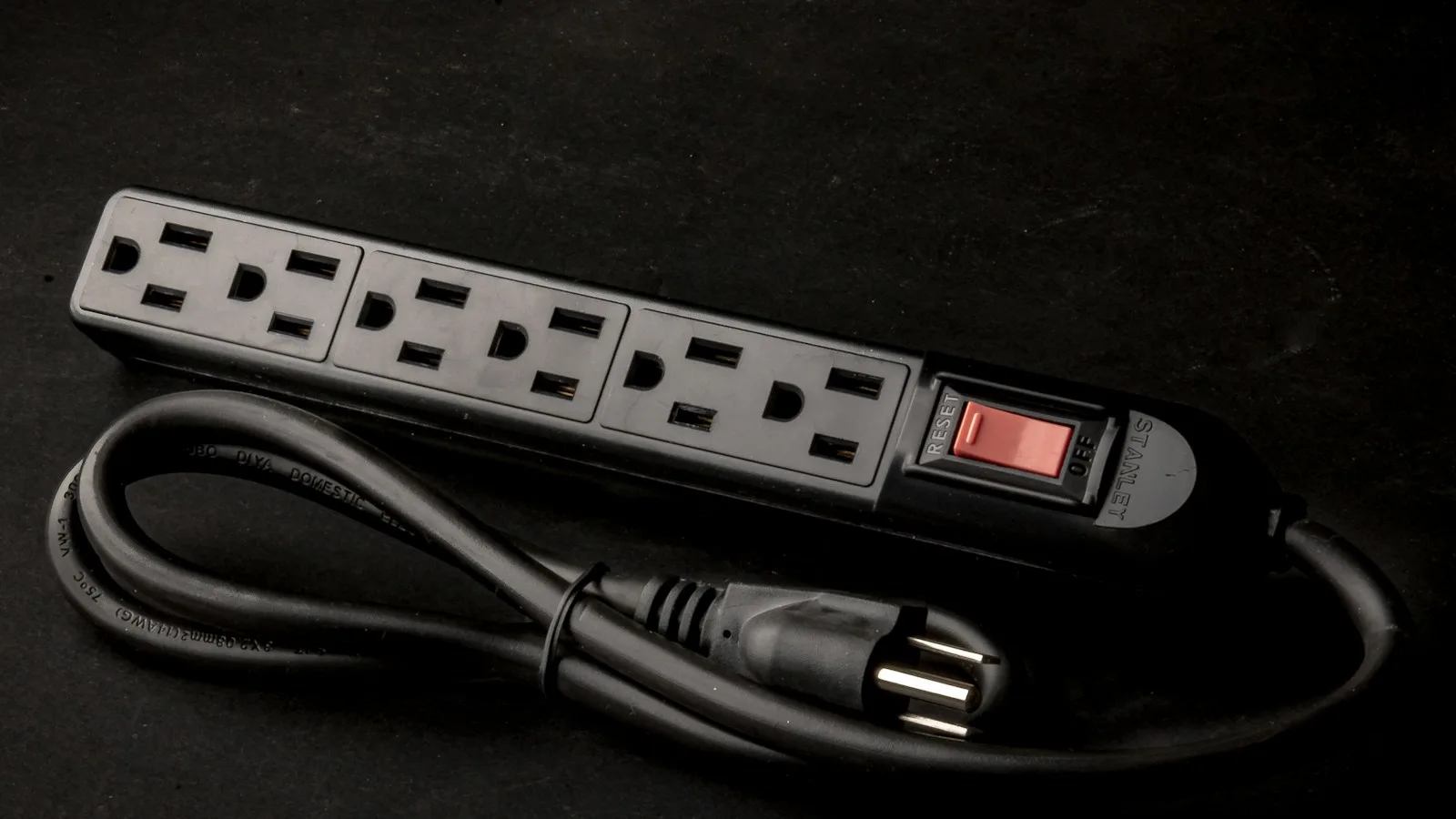
Short answer: a power strip adds outlets; a surge protector adds outlets and diverts voltage spikes away from your devices. They often look the same. Check the packaging or label for “surge protector” or “surge suppressor,” a joule rating, a UL 1449 listing and a “protected” indicator light. If none of those appear, it’s just a power strip.
Surge protector vs power strip, side by side
| Power strip | Surge protector | |
|---|---|---|
| Adds outlets | Yes | Yes |
| Diverts voltage spikes | No | Yes (MOVs inside) |
| Joule rating on label | No | Yes |
| UL 1449 listing | No (may have other safety listings) | Yes, if properly certified |
| “Protected” light | No | Usually |
| Typical use | Lamps, chargers, low-value devices | Computers, TVs, network gear |
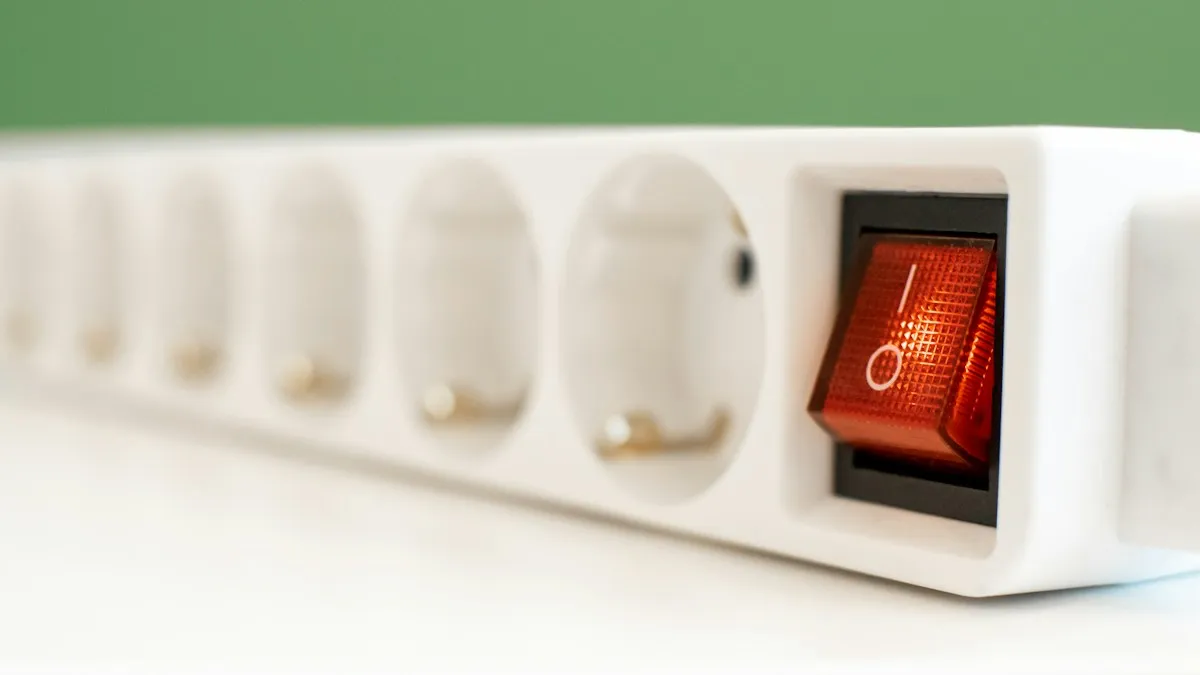
Four checks on any strip you own
- Wording: Tripp Lite notes the manufacturer’s documentation will identify the product as a surge protector or surge suppressor and give its protection specs. “Power strip” or “outlet strip” alone means no surge rating.
- Joules: a surge protector lists a joule rating. HowStuffWorks puts the minimum worth having at 200–400 joules.
- UL 1449: the standard for surge protective devices. A general safety mark alone doesn’t confirm surge protection.
- Indicator light: many protectors show a “protected” or “grounded” light. If “protected” is off, the surge components may be used up.
Do you need a surge protector?
For anything expensive or with data on it, yes. CDW’s guidance is simple: the more expensive the item, the more necessary surge suppression becomes. For a lamp or phone charger, a basic strip is fine.
How many joules? See Surge Protector Joules Explained.
Safety notes
- Don’t plug a surge protector or power strip into another one (“daisy-chaining”). Follow the manufacturer’s instructions.
- Don’t exceed the strip’s amp rating; space heaters and similar high-draw appliances usually belong directly in a wall outlet, per their manuals.
What OSHA and UL say about power strips
In an OSHA interpretation letter, the agency summarizes UL’s limits for relocatable power taps, the formal name for power strips:
- Plug them directly into a permanently installed wall receptacle.
- Don’t connect them in series to other strips or to extension cords.
- They are not intended for construction sites and similar locations.
- OSHA adds, in its own words, that these strips are not designed for high power loads.
The same applies whether the strip has surge protection or not, and whether it is plugged in at home, in a garage or in an office. A surge protector is still a multi-outlet strip when it comes to how much current it can carry.
Worked example: how much a power strip can carry
Read the amp rating on the strip’s label. If it says 15 A at 120 V, the most it can carry is 15 × 120 = 1,800 W for everything plugged in, combined. If the label lists a lower rating, such as 10 A, the limit drops to 10 × 120 = 1,200 W.
A single 1,500 W space heater would use about 83% of that on its own. That is one reason the CPSC and the U.S. Fire Administration say to plug space heaters directly into a wall outlet, never into a multi-outlet strip. The same caution goes for microwaves, kettles and other appliances that draw well over 1,000 W: give each one its own wall outlet and check the appliance manual for its instructions. More on heaters and batteries in power station space heater runtime.
Common mistakes
- Assuming any power strip protects against surges. Without a joule rating and a UL 1449 listing, it probably doesn’t.
- Plugging one strip into another to reach a desk, which UL’s listing doesn’t allow.
- Running a heater, microwave or other high-draw appliance from a strip.
- Keeping a surge protector after its protection light goes out; it may now offer no surge protection at all. See surge protector joules explained.
When this doesn’t apply
- UPS units add a battery as well as outlets. Check the spec sheet to see which outlets have surge protection and which have battery backup; see choosing a UPS for router and modem.
- Whole-home surge protection is installed at the electrical panel by a licensed electrician; it doesn’t replace point-of-use protection at your devices.
FAQ
Can I plug a surge protector into a power strip?
No. UL’s listing, as summarized by OSHA, says power strips are not to be series-connected to other power strips or to extension cords. Plug each one into a wall outlet.
Do I need a surge protector or a power strip for a TV?
A surge protector. Tripp Lite’s guidance is 1,000 joules or more for computers and AV gear, plus a UL 1449 listing.
Does a surge protector help during a power outage?
It doesn’t keep anything running; it has no battery. Its job comes when the power returns. Ready.gov warns that power may come back with momentary surges or spikes that can damage equipment, and recommends turning off or disconnecting appliances and electronics during the outage.
What does UL 1449 mean on the label?
It is the UL safety standard for surge protective devices. A listing means the product was tested to it, and the test is also where the VPR (voltage protection rating) comes from.
How do I know if my power strip has surge protection?
Look for the words “surge protector” or “surge suppressor”, a joule rating, a UL 1449 listing and a protection light. If none appear, it’s just a power strip.
Sources: OSHA, relocatable power taps; U.S. Fire Administration, space heater cords; Ready.gov, Power Outages; Tripp Lite; HowStuffWorks; CDW. Written by Lucas, Electrical Engineer.